(1).png?w=1016&h=340)
Spiral Glass Chandelier for Double-Height Staircase Spaces
Jan 06,2026
In residential interiors, double-height staircases are often architecturally impressive, yet visually underdefined. The challenge lies not in scale, but in how to organize that vertical volume in a way that feels intentional.
A vertically suspended chandelier provides a direct response. Rather than occupying a single focal point, it extends through the full height of the space, establishing a clear visual axis. This approach transforms the staircase from a transitional zone into a continuous spatial experience.
Form and Spatial Alignment
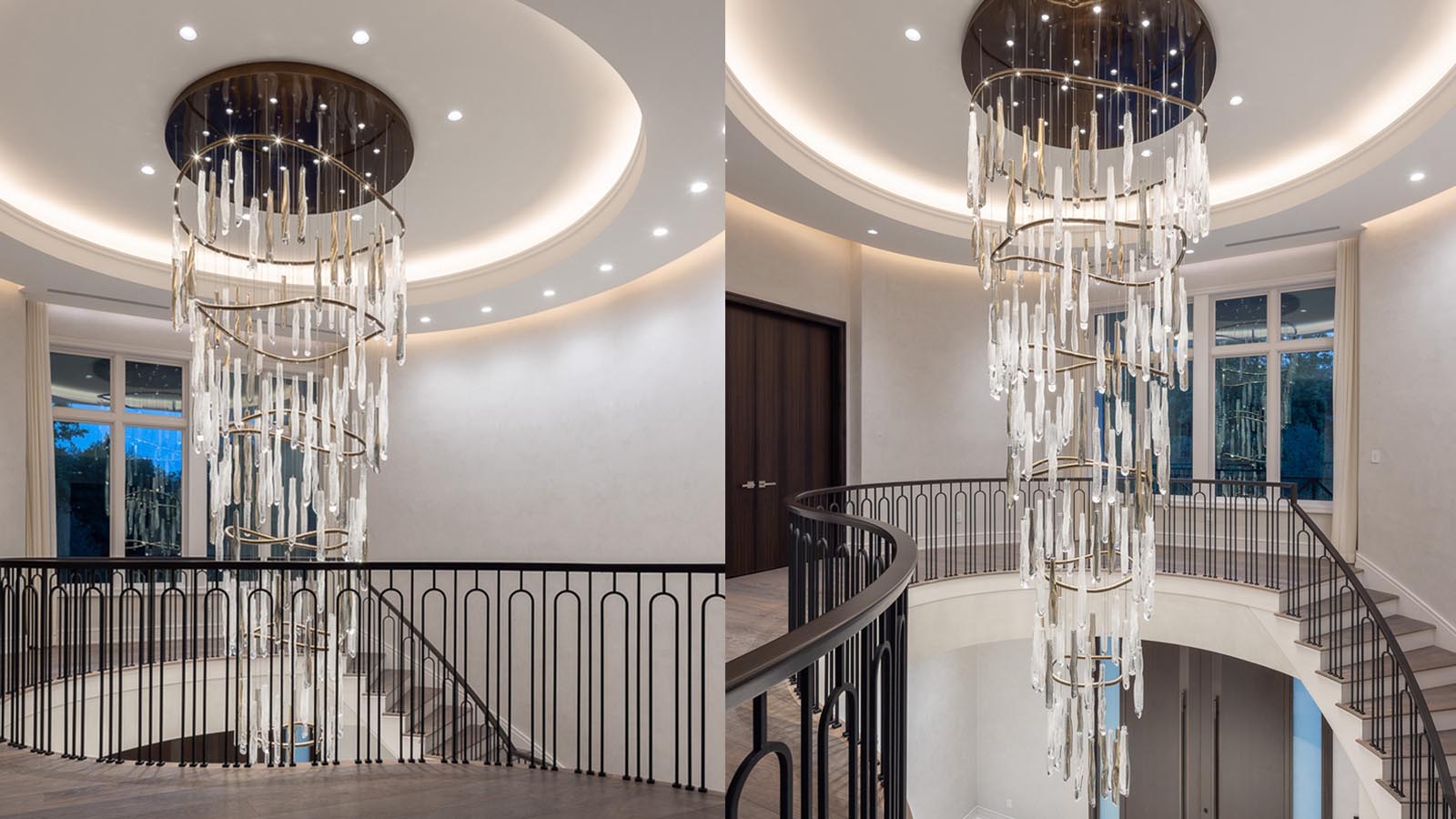
The chandelier is structured around a soft spiral composition, developed to echo the curvature of the staircase. Instead of rigid symmetry, the design introduces a controlled flow, allowing the fixture to align naturally with the architectural movement.
Multiple circular frames are arranged in layers, gradually descending through the void. This tiered configuration helps distribute visual weight evenly, ensuring that the installation feels balanced when viewed from different levels—whether from the upper landing, mid-stair, or ground floor.
Glass Elements and Material Expression
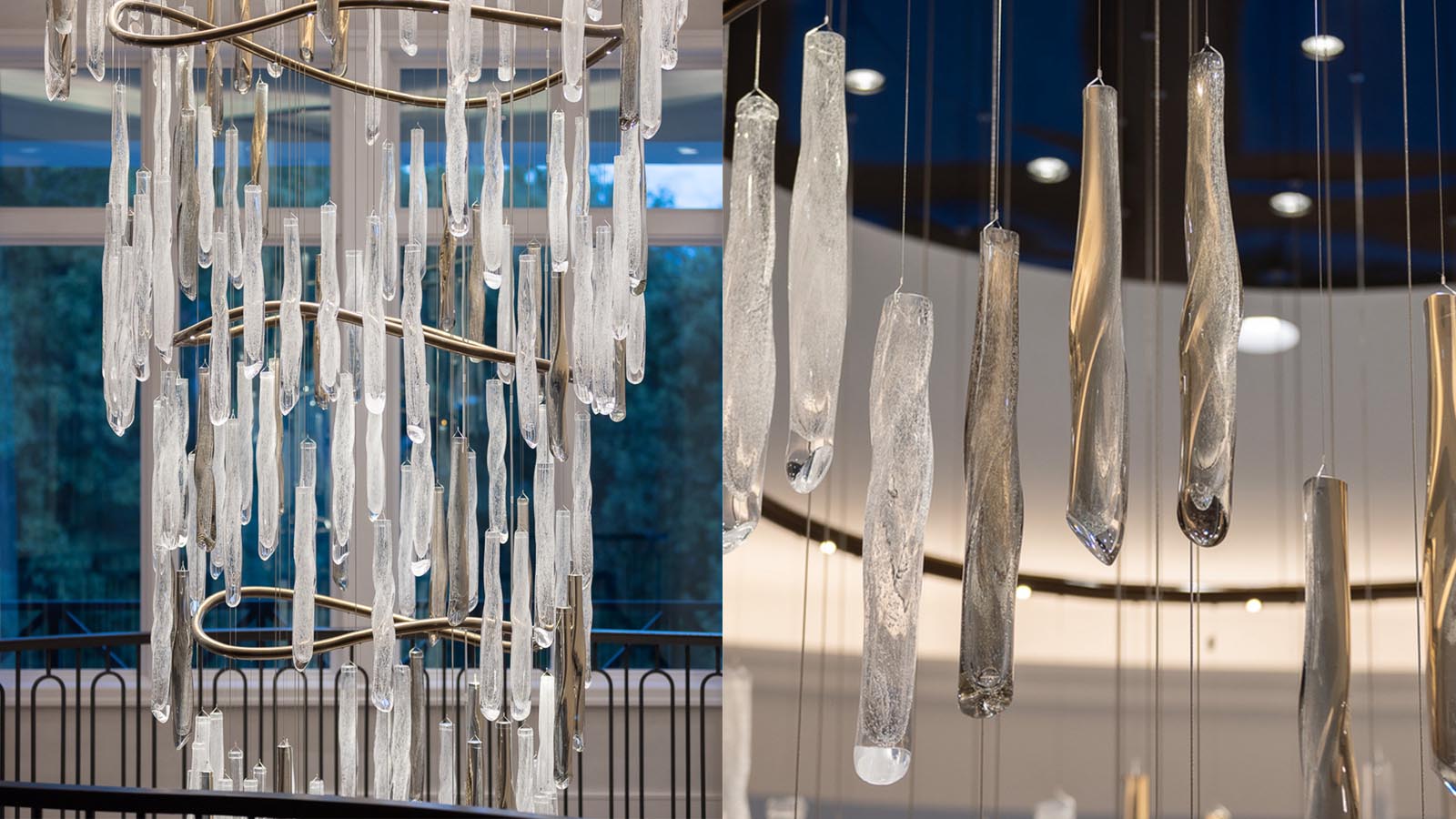
The core visual language of the fixture is defined by its suspended glass elements. Each piece is elongated and slightly irregular, avoiding uniformity. This variation introduces a more organic rhythm, preventing the chandelier from appearing overly engineered.
The glass combines clear and textured finishes. Transparent sections maintain lightness, while subtle internal textures enhance light diffusion. Together, they create depth without increasing visual density.
The supporting structure is executed in a warm metallic finish, offering a quiet contrast to the glass. Its role is structural rather than decorative, allowing the composition to remain visually focused on the suspended elements.
Lighting Strategy
Lighting is integrated discreetly within the upper framework. Instead of exposing light sources, illumination is directed downward and carried through the glass elements.
This indirect approach produces a soft, even glow, reducing glare while enhancing the material qualities of the glass. The chandelier functions not only as a visual centerpiece, but also as a primary ambient light source for the entire stairwell.
Installation and Proportion
In double-height applications, proportion is critical. The chandelier must respond to both ceiling height and stair geometry without overwhelming the space.
The vertical length of the installation is carefully calibrated to maintain clearance while preserving visual continuity between levels. Suspension points are distributed to ensure stability, particularly in designs with multiple tiers and varied element lengths.
Ceiling integration also plays an important role. A recessed circular detail helps anchor the fixture visually, reinforcing its alignment with the architectural center.
Spatial Experience
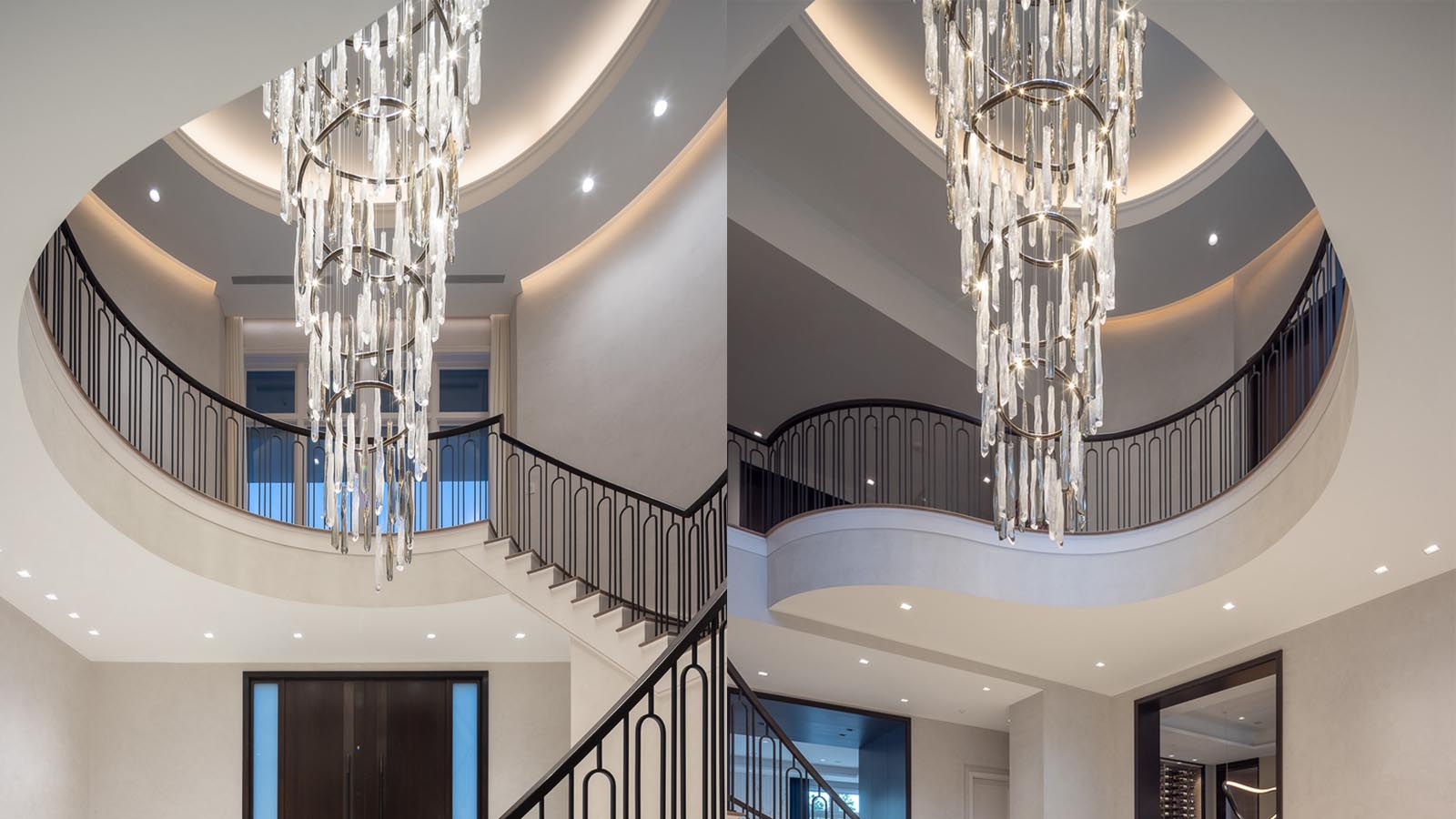
As users move through the staircase, the chandelier reveals different characteristics. From above, the composition appears layered and structured. From below, it becomes more elongated and fluid.
Light interacts with the glass surfaces to produce subtle reflections and refractions, adding depth without excessive brightness. This dynamic quality enhances the experience of vertical movement, making the staircase feel more immersive.
Overall Effect
Within the interior, the chandelier acts as a unifying element. It connects floors, softens transitions, and introduces a sense of continuity across the height of the space.
Rather than dominating the architecture, it works in parallel with it—using form, material, and light to define the atmosphere. The result is a staircase that is not only functional, but visually and spatially complete.